

Have you ever wondered why the furniture in your house has polished edges? Thanks to the edge bandings and the carpenter’s hard work, they made the dull pieces of wood look classy. You might think it is only for aesthetic reasons.
Yes, they are. But they have a purpose too. This article discusses everything from what edge bandings are to the edge banding process, types and much more.
WHAT IS EDGE BANDING? WHY DOES IT EXIST?
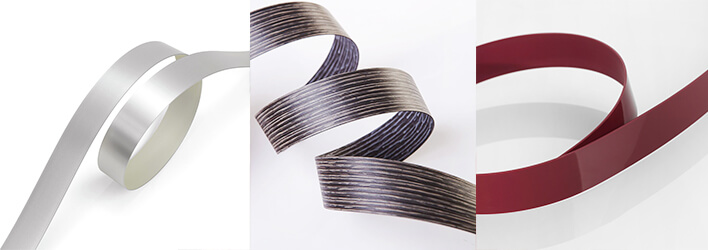
Edge bandings are narrow strips used to cover the unfinished edges of wood. These come in various materials, colors and finishes. On a commercial level, industry-grade heat applicators and a hot-melt adhesive are used during the edge banding process.
Edge banding is also the process of applying some materials to the sharp edges of furniture to create a smooth appearance. The edge banding materials include polyvinyl chloride or PVC, acrylic, wood or wood veneers, melamine, etc.
To cover the exposed ends of materials like plywood, particleboard, or MDF, edge banding is carried out. This process not only gives your furniture an impressive finish but also increases the life span of the furniture.
Besides, if you do not apply edge banding substances, it will absorb moisture from the outside environment and gradually start rotting. Therefore, to make the furniture durable and aesthetic, edge banding is essential.
The application of banding in the edges also increases the tensile strength of the material. Edge bandings are also applied to repair a damaged portion or give a new look to the furniture.
In modular furniture, wood is treated to make moisture resistant. However, the humidity imbibing timber property cannot be terminated entirely; it can only be lessened to certain extents. Edge banding is a suitable alternative to make edges water-resistant.
HOW IS EDGE BANDING PROCESS CARRIED OUT?
Nowadays, with the advancement of technology, edge banding process is carried out efficiently by machines.
The machines used to do edge banding is called an edge bander. A hot-melt adherent is utilized to apply the bandings to the edges of wooden frames. Hot melt adherent is composed of raw materials like EVA, PUR, PA, APOA, etc. Between the adhesive and the substrate, a substrate primer is used as a bridge.
A heat roller is then run to weld the edge band over the wood surface. The edge bander trims off the leading and trailing ends, top and bottom flushes or scrapes off any residue to give it a clean look.
DIFFERENT TYPES OF EDGE BANDINGS
PMMA 3D Acrylic edge bandings: These are smooth and high-glossy and are usually customized as per the texture and color of the customer’s sample. They are manufactured in uni-color, bi-color and tri-color. Thickness and width again depend on customer’s specifications. These are eco-friendly and ideal for use in kitchen, bathroom, offices and shops where look and functionality both are needed.
Made using high-quality acrylic resin, they are highly transparent, weather resistant, impact resistant, and abrasion resistant. PMMA is highly resistant to wear and tear of any kind and have all the characteristics of 3D material.
Acrylonitrile Butadiene Styrene (ABS) edge bandings: Like PVC, ABS is also manufactured in the same way, but it is lighter in weight because of the less density. The element chlorine is not incorporated in the chemical manufacturing of ABS.
The best part with ABS is the composition of 100 percent recyclable materials; therefore, it doesn’t cause any residual effect in the environment.
Poly Vinyl Chloride (PVC): PVC polymers are solid with greater stability. It is strong enough to sustain any kind of shocks and collisions, foreign chemicals, and ultraviolet radiation.
Why PVC is the most popular type of edge banding among carpenters because of its impermeability to moisture. Besides, it can be molded to any shape very quickly according to the wood frame’s dimensions.
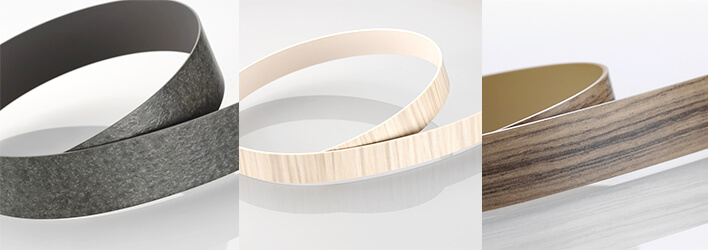
PVC edge bandings offer great protection for moldings. They are flexible and do not deform even when bent. These can be manufactured in various surface types like glossy, wood grain, linen pitted and more
Polypropylene (PP): PP polymer exhibits thermoplasticity. It doesn’t react with other chemicals and offers great resistance to cracks. PP is chosen to prevent eroding and chemical leaching.
PP is easily degradable and doesn’t require any time-consuming parting of edge bands from frames. The property of joining by heat fusion instead of gluing makes it the handiest amongst other edge bandings.
Melamine: Melamine is preferable to use in interior furniture.
Veener edge banding: For a clean and shining look of your plywood or veneered panel, veneer edge banding is the perfect option. Veneer means the thin sections of wood that have been pre-sanded and layered concurrently. Popular wood species are oak, mahogany, maple, etc. You can apply veneer edge bandings on raw plywood edges it will be hard to distinguish it from solid wood.
Laser Edge banding or Zero Joint Edge banding: This type is adhesive-free and hides the sharp edges in a manner so that it becomes indistinguishable.
WHAT SIZE OF THE EDGE BANDING DO YOU NEED?
Edge bandings come in various thickness and width dimensions and can be used depending on type of furniture, where it needs to be used and other factors. It is essential to use the right kind of bandings to ensure utmost lasting.
For example, you can buy embossed edge banding in width 18mm-150mm and thickness can range between 0.4 mm-3mm. On the other hand, wood grain PVC edge banding thickness can be 0.4mm to3mm and width can be 18mm to 150 mm.
In home office, edge banding of 0.5 mm thickness is used to cut off the extra costs. For places like the kitchen and bathroom, the edge banding should be kept 1 mm thick. Since the kitchen and bathroom cabinets are highly used; therefore for durability, thick edge bandings are needed. An edge banding of 3 mm thickness is placed in commercial offices or showrooms to ensure longevity and resilience.
ABOUT THE EDGE BANDING YANGMAN MANUFACTURER
Guangzhou Young Plastic Ltd. is a high-quality manufacturer of edge banding materials. The company has a team of experienced professionals and the most-advanced production equipment to make quality edge bandings. They emphasize on product quality, and that is why they use imported raw materials.
The company manufactures PVC edge banding, ABS edge banding, 3D acrylic edge banding, PVC profile and hot melt adhesive. They follow stringent processes and focus on client satisfaction through high-quality edge bandings. Service is also excellent. The company sells edge bandings and other products in Europe, South America, and Asia apart from many cities in China.